The Hidden Dangers of DIY Tree Removal: Why Denver Homeowners Should Call Pros are often overlooked by well-meaning residents looking to save money or tackle a weekend project. While Colorado has a strong culture of self-reliance and DIY home improvement, tree removal is a high-stakes operation that carries risks far beyond those of a standard landscaping task. In the Denver metro area, where our urban forest faces unique challenges from heavy spring snows to the invasive Emerald Ash Borer, understanding the complexity of tree health is vital. Attempting to fell a large tree without professional training can lead to catastrophic property damage, severe personal injury, or even fatalities. At Above & Beyond Services, we have seen firsthand the consequences of DIY attempts gone wrong. From branches crashing through roofs to homeowners getting caught in power lines, the ‘savings’ of doing it yourself often evaporate instantly when emergency repairs or medical bills arise. This comprehensive guide explores why professional intervention is not just a convenience, but a necessity for maintaining a safe and beautiful Colorado landscape.
The Physics of Tree Removal: More Than Just a Saw
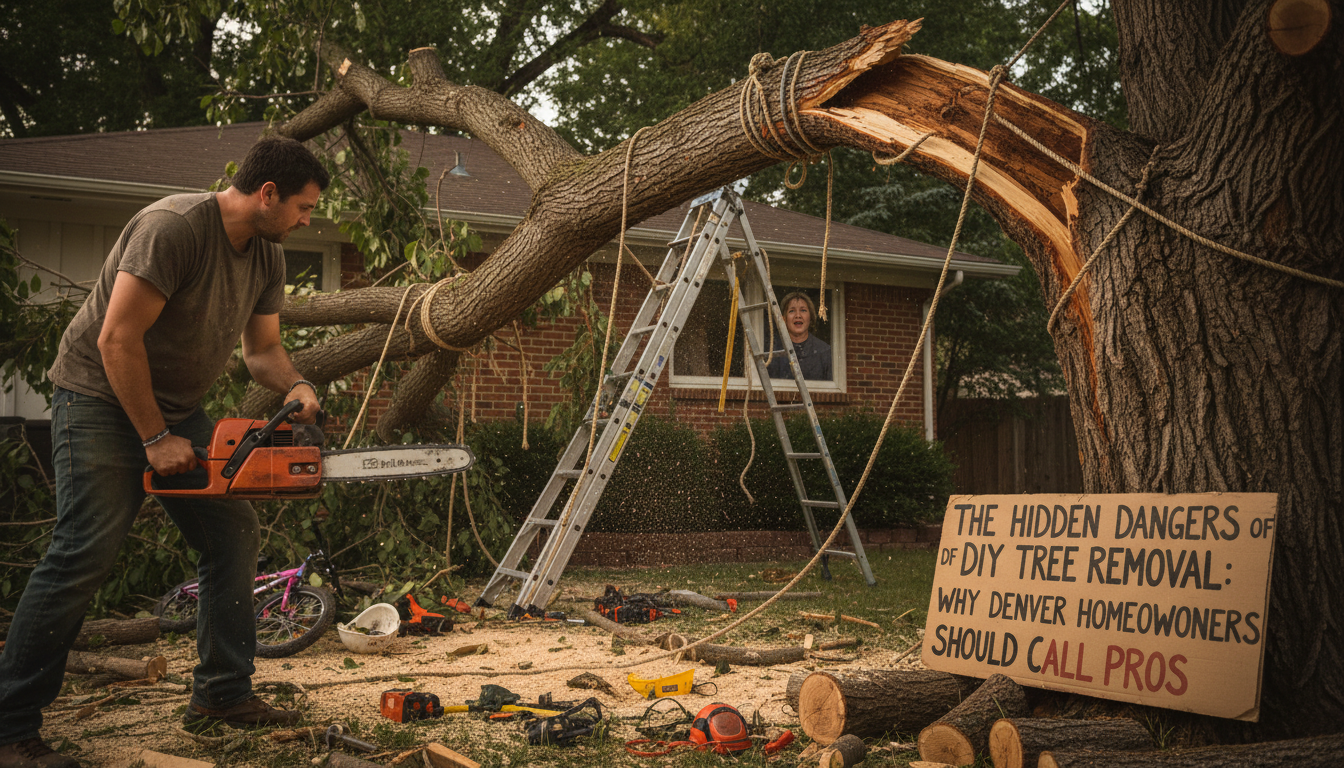
Many homeowners assume that removing a tree is as simple as making a few cuts with a chainsaw and letting gravity do the rest. In reality, tree removal involves complex physics, weight distribution, and tension dynamics. A mature tree in Denver, such as a large Plains Cottonwood or a Silver Maple, can weigh several tons. When you begin cutting, the center of gravity shifts unpredictably. If the tree has internal rot—which is common in older Denver neighborhoods—the structural integrity may be compromised in ways that are invisible from the outside. Professional arborists use a technique called ‘rigging’ to control the descent of every limb. This involves high-strength ropes, pulleys, and friction devices to ensure that heavy wood is lowered slowly and safely. Without this equipment, a falling branch can bounce, swing, or ‘kick back’ toward the operator with enough force to crush a human or destroy a fence. Furthermore, the ‘felling zone’—the area where a tree might land—is often much larger than people realize. A 50-foot tree requires a clear radius that accounts for unexpected twists or breaks during the fall. Another dangerous phenomenon is the ‘barber chair.’ This occurs when a tree begins to fall before the back cut is complete, causing the trunk to split vertically. The back portion of the tree can then kick upward and backward with lethal speed. Only a licensed arborist denver has the training to recognize the tension in the wood and apply specific notch cuts to prevent this outcome.
Tree Removal Safety: Understanding the Risks to Life and Limb
When discussing tree removal safety, the statistics are sobering. According to data from the Tree Care Industry Association, incidents involving falls, struck-by accidents, and electrocutions are frequent among non-professionals. For a homeowner standing on a ladder with a chainsaw, the risk is compounded exponentially. Ladders are designed for stable, vertical work; they are not designed to withstand the lateral force of a shifting tree limb or the vibration of a heavy saw. Furthermore, chainsaws themselves are incredibly dangerous tools. A ‘kickback’ occurs when the tip of the chainsaw blade hits a hard object or gets pinched in the wood, causing the saw to fly back toward the operator’s face or chest. Professional crews wear full Personal Protective Equipment (PPE), including Kevlar chaps, helmets with face shields, and ear protection. Most DIYers lack this specialized gear, leaving them vulnerable to life-altering injuries from even a minor slip. Beyond the saw, there is the risk of electrocution. Many of Denver’s residential trees grow near or through overhead power lines. Even if a branch isn’t touching a wire, electricity can ‘arc’ across a gap, especially in the humid or snowy conditions common in the Foothills. Professionals coordinate with local utility companies to ensure lines are de-energized or shielded before work begins, a step most homeowners skip.
The Legal and Financial Risks of DIY Removal
One of the most overlooked aspects of DIY tree removal is liability. If a homeowner attempts to remove a tree and it falls on a neighbor’s house or a parked car, their standard homeowners’ insurance policy may not cover the damage if it is determined that the work was performed by an unlicensed individual. This can lead to tens of thousands of dollars in out-of-pocket expenses and potential lawsuits. When you hire a licensed arborist denver, you are paying for more than just labor; you are paying for insurance coverage. Above & Beyond Services carries comprehensive general liability and workers’ compensation insurance. This means if an accident occurs on your property, the burden of responsibility lies with the company, not the homeowner. In a city like Denver, where property values are high and houses are often built close together, this financial protection is indispensable. Additionally, there are municipal regulations to consider. Some Denver neighborhoods have protected tree species or historical designations that require specific permits for removal. Cutting down a protected tree without authorization can result in significant fines from the city. A professional service handles the permitting process, ensuring that all work is compliant with local ordinances.
Understanding the Real Cost of Tree Removal in Denver
When homeowners search for the cost of tree removal denver, they often see a wide range of prices. It is tempting to choose the cheapest option or try to do it yourself to save money. However, the price reflects several critical factors: the size of the tree, its proximity to structures, its overall health, and the equipment required. A tree overhanging a sunroom requires a crane or intricate bucket truck work, which naturally increases the cost but ensures the safety of your home. DIY costs are also higher than they appear. You must factor in the rental of a high-powered chainsaw, the purchase of safety gear, the rental of a wood chipper, and the fees for hauling away several tons of debris. In many cases, once you add up the time spent and the equipment rented, the professional quote is surprisingly competitive. Moreover, professionals can often combine services. For instance, while removing a dead tree, we can also perform tree trimming on nearby healthy specimens to prevent future hazards. Investing in professional removal is also an investment in your property value. A stump left behind from a DIY job can become a breeding ground for pests like termites or carpenter ants, which may eventually migrate to your home. Professionals offer stump grinding services that leave your lawn ready for new growth or landscaping, protecting your curb appeal.
Identifying the Need for Emergency Tree Removal
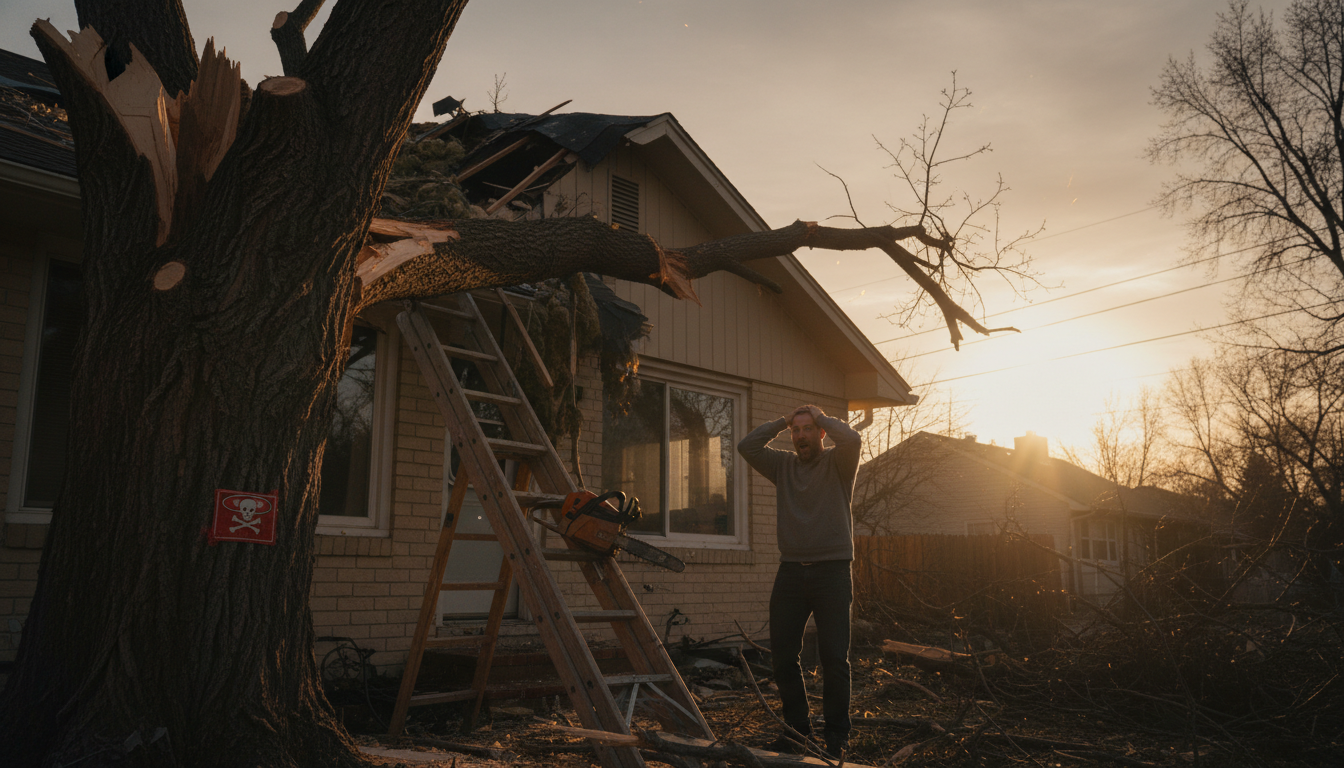
Colorado’s weather is notoriously unpredictable. Late-season heavy snows in May or sudden wind gusts off the Rockies can turn a seemingly healthy tree into a hazard overnight. Knowing when to call for emergency tree removal is critical for preventing injury. If you notice a tree leaning suddenly, large cracks in the trunk, or roots pulling out of the soil (heaving), the situation is urgent. Other signs include ‘widowmakers’—large dead branches hanging precariously in the canopy—or fungal growth at the base of the tree, which indicates internal rot. If a storm has already caused a limb to fall onto your roof or power lines, do not attempt to clear it yourself. The tension in a downed tree is extremely high, and moving one branch can cause the entire structure to shift or collapse further. Professional emergency teams have the gear to work safely in dark or wet conditions, using specialized lighting and heavy machinery to stabilize the situation. Above & Beyond Services provides rapid response for these scenarios, helping Denver residents secure their property before the next wave of weather hits. To learn more about identifying risks, check out our guide on signs your trees need pruning, which often covers the early warning signs of a failing tree.
The Environmental and Biological Impact
Tree removal is not just about the tree itself; it’s about the entire ecosystem of your yard. Denver has been hit hard by the Emerald Ash Borer (EAB), an invasive beetle that kills ash trees. Removing an infested tree requires specific disposal protocols to prevent the spread of the beetle to your neighbors’ properties. A DIYer might unknowingly transport infested wood to a different area, accelerating the environmental damage. Furthermore, trees are often home to local wildlife. In Colorado, we frequently deal with squirrels, raccoons, and birds nesting in older trees. A professional arborist can identify if a tree is currently inhabited and may recommend the best time for removal to minimize the impact on local fauna. This intersection of tree care and wildlife management is where Above & Beyond Services excels, as we understand the biological needs of both the flora and fauna in the Denver area. Healthy soil is another consideration. Dragging heavy logs across a lawn can compact the soil, killing the grass and damaging the roots of nearby healthy trees. Professional crews use ground protection mats and specialized equipment to minimize the ‘footprint’ of the removal process, ensuring that your landscape remains healthy after the job is done.
The Specialized Tools of the Trade
Why can’t a standard chainsaw from a big-box store do the job? Professional tree removal requires industrial-grade equipment that most homeowners cannot access. This includes high-capacity wood chippers that can process entire limbs in seconds, stump grinders with carbide-tipped teeth, and aerial lifts that reach 60 to 100 feet into the air. More importantly, professionals use specialized rigging gear. This includes arborist-grade blocks (pulleys), ‘Port-a-Wraps’ for controlling heavy loads, and dynamic climbing ropes. These tools are rated for thousands of pounds of force. Using hardware-store rope or basic tie-downs for tree work is a recipe for failure. If a rope snaps under the weight of a falling limb, the resulting ‘snap-back’ can be as dangerous as the falling wood itself. Modern arboriculture also utilizes diagnostic tools. We use resistographs and sonic tomography to ‘see’ inside a tree trunk. These tools tell us exactly how much sound wood is left, allowing us to determine if a tree can be saved through plant health care or if removal is the only safe option. This scientific approach removes the guesswork that leads to DIY accidents.
Why Denver’s Climate Makes DIY Even Harder
Denver sits at 5,280 feet, and the altitude affects more than just your breathing. Trees at this elevation grow differently than those at sea level. They are often subject to intense UV radiation, low humidity, and rapid temperature swings (the ‘Greeley Flash Freeze’ effect). These factors can make wood more brittle and prone to shattering when cut. Additionally, the ‘upslope’ snowstorms common in the Denver metro area apply massive weight to evergreen needles and deciduous leaves. A tree that looks fine in summer may be structurally unsound by October. When a DIYer attempts to remove a tree that has been weakened by altitude-related stress, the wood may not behave as expected. It may ‘shatter’ or split along frost cracks, creating unpredictable falling patterns. Professionals who have worked in the Front Range for years understand these local nuances and adjust their cutting strategies accordingly. According to the International Society of Arboriculture (ISA), professional standards are constantly evolving to address these regional challenges. Hiring an ISA-certified arborist ensures that your tree removal is handled according to the latest scientific research and safety protocols.
Case Study: The Cost of a ‘Simple’ Mistake
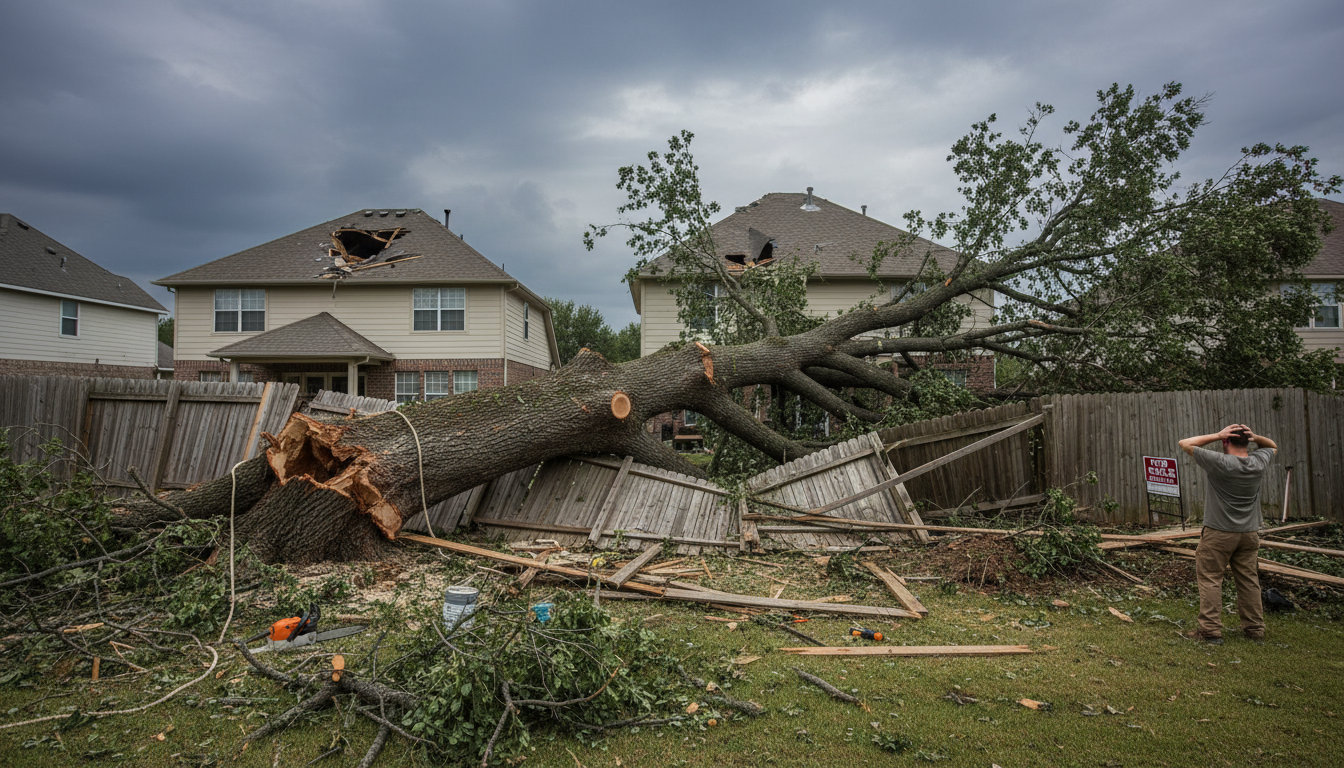
To illustrate the dangers, consider a common scenario in a suburb like Centennial or Aurora. A homeowner decides to remove a dead 30-foot Pine tree located five feet from their garage. They buy a saw, watch a few videos, and start cutting. Halfway through the felling cut, a gust of wind catches the canopy. Because the homeowner didn’t know how to set a ‘directional wedge,’ the tree twists and falls directly onto the garage roof. In this scenario, the homeowner now faces: 1. A $5,000 to $10,000 roof repair bill. 2. Potential structural damage to the garage frame. 3. The cost of a professional to come out and safely remove the tree from the roof (which is much more expensive than a standard removal). 4. A possible increase in insurance premiums or a denied claim. If they had called a professional initially, the job would have been completed in a few hours, safely, for a fraction of the eventual repair costs. This ‘hidden danger’ of DIY is the financial gamble that homeowners take every time they pick up a saw.
In conclusion, while the urge to handle home maintenance personally is admirable, tree removal is a task that should always be left to the experts. The physical risks of falling limbs, the mechanical dangers of high-powered saws, and the complex liability issues make DIY tree removal a high-risk, low-reward endeavor.
By choosing a professional team like Above & Beyond Services, you ensure that your property remains safe, your liability is protected, and your landscape is treated with the scientific care it deserves. Whether you are dealing with a storm-damaged tree that requires emergency tree removal or simply need a dead tree cleared to make way for new growth, our team of experts is here to help. Don’t risk your safety or your home’s value on a dangerous DIY project. Contact Above & Beyond Services today for a professional consultation and ensure your Denver property stays beautiful and hazard-free for years to come. Visit our contact page to get started.